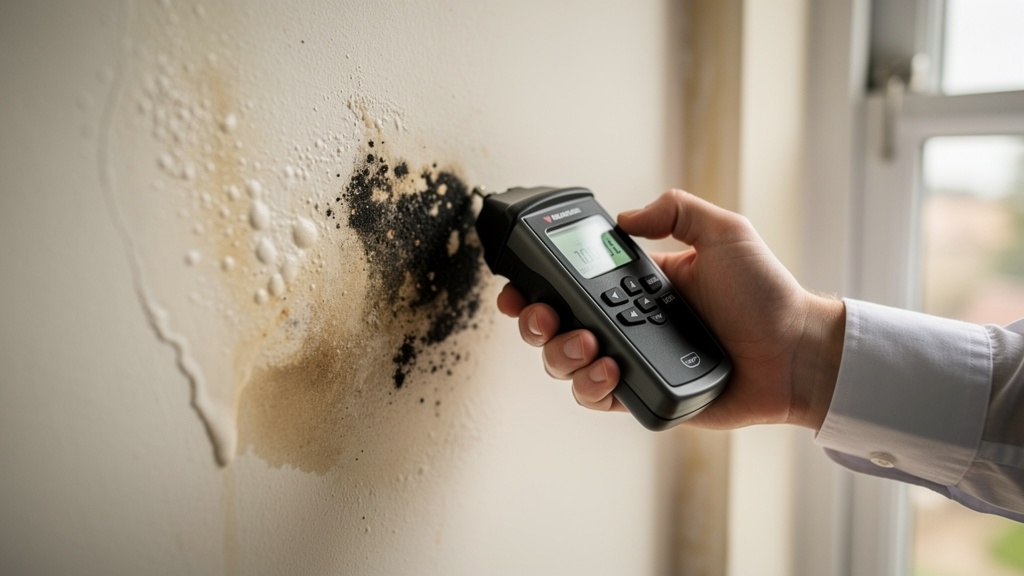
Damp is one of the most common – and most misunderstood – issues in British property. I've surveyed thousands of homes across Surrey and I'd estimate that damp of some kind appears in the majority of older properties I inspect. But not all damp is equal, and the treatment varies enormously depending on what type you're dealing with.
This is my plain-English guide to the three main types of damp we encounter in Surrey homes. Understanding the differences could save you thousands in unnecessary (and ineffective) treatment.
Type 1: Rising Damp
Rising damp is moisture from the ground that travels upward through masonry walls by capillary action – essentially the same process by which a sponge absorbs water. It's limited in height by gravity and typically affects walls only up to about 1–1.5 metres from the floor.
Signs of rising damp
- A "tide mark" or staining at low level on internal walls
- White crystalline salts (efflorescence) appearing on the plaster or brickwork
- Blown or bubbling plaster at low level
- Peeling wallpaper or paint at skirting level
- A damp, musty smell concentrated at floor level
Causes and remedies
Rising damp occurs when the damp-proof course (DPC) – the horizontal barrier in the wall that prevents moisture migration – is absent, failed, bridged (by raised ground levels, render, or debris in cavity walls), or insufficient.
The correct remedy is to install or restore the DPC. This usually involves injecting a chemical DPC into the mortar course and then re-plastering with a salt-resistant renovating plaster. It should be carried out by a qualified specialist – a good one will identify and address the cause before treating the symptoms.
Typical cost in Surrey: £800–£2,500 per affected wall
Important Warning
Be wary of damp specialists who diagnose rising damp too quickly without carrying out proper moisture meter tests. In our experience, a significant proportion of cases initially attributed to rising damp turn out to be condensation or penetrating damp – both of which require completely different treatments and are often much less expensive to fix.
Type 2: Penetrating Damp
Penetrating damp is caused by water entering the property from outside through defects in the external envelope. Unlike rising damp, it can appear at any height and in any part of the building.
Signs of penetrating damp
- Damp patches that appear after rain and dry out in dry weather
- Damp staining on external walls that corresponds with a defect in the pointing or render
- Water ingress around windows, doors or where different materials meet
- Damp appearing below a flat roof or parapet wall
- Staining on ceilings that gets worse during or after rainfall
Common causes in Surrey homes
- Failed or missing mortar pointing (particularly in exposed locations)
- Cracked or failed render
- Blocked or leaking rainwater goods (gutters and downpipes)
- Missing or cracked roof tiles
- Failed lead flashings at chimney or dormer junctions
- Defective window and door seals and flashings
The remedy is always to identify and eliminate the source of water ingress first. Only once the external defect is repaired should any internal damage be made good.
Typical cost: £300–£3,000+ depending on cause and extent
Type 3: Condensation Damp
Condensation is by far the most common form of moisture-related problem in UK homes – and the one most often misdiagnosed as rising or penetrating damp. It occurs when warm, moist air comes into contact with a cold surface (typically an external wall) and the moisture condenses out of the air.
Signs of condensation
- Mould growth, typically starting in corners at high level or behind furniture
- Misting on windows
- Damp that appears in winter and improves in summer
- Damp that affects internal partition walls as well as external walls
- Musty smell throughout the property
Causes and remedies
Condensation is a lifestyle and ventilation issue as much as a structural one. It's made worse by: insufficient heating, poor ventilation (blocked airbricks, sealed windows), drying laundry indoors, and cooking without extractor fans. Modern, well-insulated homes can also suffer if they're too airtight.
Remedies include: improving ventilation (particularly in kitchens and bathrooms), using extractor fans consistently, maintaining an even background heat, improving insulation to raise surface temperatures, and in some cases installing a Positive Input Ventilation (PIV) unit.
Typical cost: £0 (behavioural changes) to £800–£1,500 for a PIV unit installation
Why Getting the Diagnosis Right Matters
In one case I attended in Woking, a homeowner had spent £4,500 on chemical DPC injection and replastering after being diagnosed with rising damp by a specialist. The damp returned within months. When I surveyed the property, it became clear the issue was penetrating damp caused by a blocked gutter and failed pointing – both of which were fixed for £350. The £4,500 had been almost entirely wasted.
This is exactly why an independent defect analysis from a surveyor is so valuable. We have no financial incentive to recommend a particular treatment, and we use calibrated professional equipment (not just a basic meter) to diagnose the issue correctly before recommending any remediation.
Frequently Asked Questions
Not automatically. Damp is extremely common in older properties, and in many cases it's easily and cheaply fixed. What matters is understanding what type of damp you're dealing with, what's causing it, and what it will cost to fix. Our surveys identify all three. Once you have that information, you can make an informed decision about whether to proceed – and if so, whether to negotiate the price.
For condensation, improving ventilation and maintaining a steady background heat can make a significant difference and costs nothing. For rising and penetrating damp, we'd always recommend getting a professional assessment before attempting any treatment. Treating the wrong type of damp with the wrong remedy is expensive and ineffective.
We use a calibrated moisture meter to take readings at multiple points across the affected area. We also use our professional judgement and experience to assess the pattern of damp, look for associated defects and understand the construction of the building. We do not simply point a basic meter at a wall and declare the result. A thorough damp assessment takes time and knowledge.
Yes, potentially significantly. Untreated damp – especially rising damp – can affect a mortgage lender's willingness to lend, and it can give buyers (and their surveyors) reason to negotiate on price. Our survey reports include estimated repair costs specifically so that clients can use these figures in price negotiations with the seller.
Condensation damp that results in mould growth can pose health risks, particularly for children, the elderly and those with respiratory conditions. Both the NHS and NICE have published guidance confirming the link between damp and mould in homes and respiratory illness. This is an area of increasing concern from both a health and housing regulation perspective.